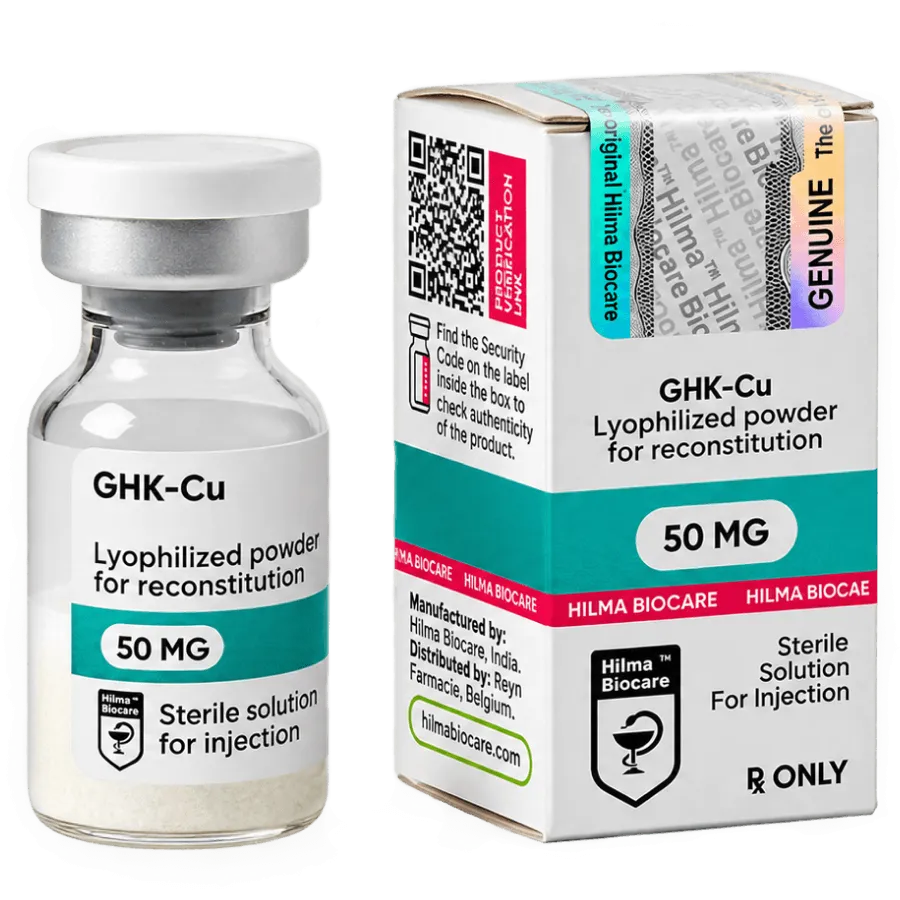
GHK-Cu (Copper Tripeptide-1) is a signal peptide consisting of three amino acids: glycine, histidine, and lysine, structurally linked to copper. It is an important regulator of the regenerative process in many tissues and organs, including the skin. Due to its small molecule size, it easily moves in the intercellular space, regulating the concentration of copper ions, which is essential for the proper functioning of enzymes in the human body.
The product is administered subcutaneously into fatty tissue (usually in the abdominal area). It is recommended to alternate the injection site with each injection.
The dosage regimen is individualized, depending on the treatment goals. Studies have shown the effectiveness of the following regimen: a 30-day cycle divided into two 15-day phases. Dosage: days 1-15 – 1 mg/day, days 16-30 – 2 mg/day. This regimen is based on the fact that GHK-Cu acts through cumulative tissue exposure rather than through peak concentrations. Starting with a lower dose allows the tissues to respond without overstimulation. Increasing the dose on days 16-30 is intended to enhance the signaling pathways activated in phase 1. If necessary, the cycle can be repeated after a 30-day break.
The dose is administered in a single injection. If an injection day is missed, simply continue the course as usual, without doubling the dose the following day.
GHK-Cu combines well with most peptides used in regenerative therapy protocols. Coadministration with NAD+ or N-Acetyl Semax is common. GHK-Cu belongs to a different mechanistic category than cognitive peptides such as N-Acetyl Semax or energy peptides such as NAD+, meaning there is no duplication when combining them.
Do not mix different peptides in the same syringe or vial. Each peptide is administered separately, from its own vial, using its own syringe. Consult your physician regarding dosage and drug interactions.
GHK-Cu is generally well-tolerated, with no side effects when used correctly. The most common reaction is mild redness at the injection site.
GHK-Cu is contraindicated in patients with active malignancies. Patients with a history of hormone-dependent cancers should discuss the use of GHK-Cu with their oncologist before starting the treatment protocol.
GHK-Cu should also not be used during pregnancy and lactation due to insufficient safety data.
<a href="https://www.freepik.com/free-vector/blue-3d-particles-background-design_3086334.htm">Image by starline on Freepik</a>
<a href="https://www.freepik.com/free-vector/composed-particles-swirling-abstract-graphics-background-sense-science-technology_14803660.htm#from_view=detail_alsolike">Image by liuzishan on Freepik</a>
<a href="https://www.freepik.com/free-ai-image/fit-individual-doing-sport_279262771.htm#fromView=serie&position=15">Image by freepik</a>
<a href="https://www.freepik.com/free-ai-image/fit-individual-doing-sport_279262698.htm">Image by freepik</a><a href="https://www.freepik.com/free-ai-image/fit-individual-doing-sport_279263078.htm#fromView=serie&position=34">Image by freepik</a>
<a href="https://www.freepik.com/free-ai-image/view-male-heavy-weight-lifter_96363713.htm#fromView=search&page=4&position=21&uuid=302d8d6f-cc6b-4434-bd1a-f91bc61108ae">Image by freepik</a>
<a href="https://www.freepik.com/free-ai-image/close-up-athlete-training_72628497.htm#fromView=search&page=7&position=34&uuid=302d8d6f-cc6b-4434-bd1a-f91bc61108ae">Image by freepik</a>
<a href="https://www.freepik.com/free-photo/office-hardware_5400371.htm#fromView=search&page=5&position=39&uuid=14ae4402-6de7-46dd-b220-795ab1624c02">Image by pressfoto on Freepik</a>
<a href="https://www.freepik.com/free-photo/medium-shot-delivery-man-holding-box_16379966.htm#fromView=search&page=7&position=2&uuid=47020c14-d929-48c7-95b1-9457ab53c444">Image by freepik</a>
<a href="https://www.freepik.com/free-ai-image/black-friday-sales-sign-neon-light_325233239.htm#fromView=search&page=1&position=6&uuid=d96897dc-a421-465f-ba54-9fdf58e941f1">Image by freepik</a>
